Linking South Bend: Delivering the Link Trail Through Collaboration and Innovation
South Bend just got a whole lot more connected. Completed in April 2025, the Link Trail is a 1.5-mile, multi-use corridor linking the University of Notre Dame to downtown. Designed with pedestrians and cyclists in mind, this trail turns everyday streets into safe, vibrant, and inviting spaces, without disrupting vehicular traffic. Beyond its physical improvements, the Link Trail is also a case study in collaboration under pressure, showcasing how municipalities, academic institutions, and engineering consultants can deliver complex projects on accelerated schedules.
A Design That Puts People First Built entirely within the existing right-of-way, the Link Trail demonstrates the power of thoughtful urban planning and adaptable, solution-oriented design. The project stretches along LaSalle Avenue, Hill Street, South Bend Avenue, Notre Dame Avenue, and Angela Boulevard, featuring:
Wide multi-use path with raised crosswalks and separate sidewalks
Enhanced lighting and traffic-calming features
Thoughtful landscaping and signature wayfinding signage
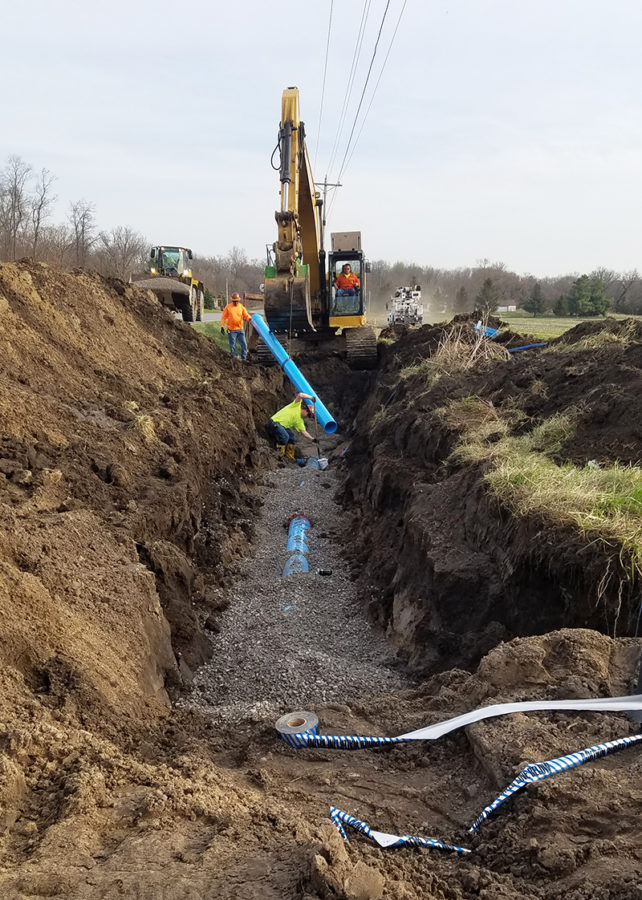
Upgrades to underground infrastructure, including storm sewer, sanitary sewer, and water main improvements
These improvements create a safer, more attractive route while maintaining smooth traffic flow with a proper Complete Streets approach. Early coordination with stakeholders, including AEP on high-voltage transmission line crossings, ensured the project remained on schedule and safe for the community.
Meeting the Community’s Needs Before the trail, students and residents had limited options for non-vehicular travel between the campus and downtown. The Link Trail now:
Reduces traffic congestion, especially during Notre Dame football weekends
The project highlights the unique role of Notre Dame students, who supported research, community engagement, and project planning. Their involvement added valuable insight and reinforced the trail’s connection to local learning and civic participation.
More Than a Trail: A Placemaking Triumph Robust public engagement shaped the project from day one. Residents influenced key design choices, ensuring the trail reflects the community’s vision. Signature branding and landscaping make it instantly recognizable, while programming led by Visit South Bend and the University of Notre Dame, including community walks and student activities, keeps the space active and welcoming. To help measure this success, MACOG received a grant to install a trail counter. The data collected will track trail usage, giving planners and community leaders valuable insight into how the Link Trail supports mobility, recreation, and economic vitality.
A Model for Collaboration Funded through a public-private partnership, with equal contributions from the City of South Bend, Visit South Bend Mishawaka, and the University of Notre Dame, the Link Trail demonstrates what’s possible when stakeholders unite behind a shared vision. At $11.5 million, South Bend’s most significant transportation-related investment is tied to the university and sets a new standard for urban placemaking. This project illustrates how early coordination, open communication, and adaptable planning can allow complex, multi-phase infrastructure projects to succeed under tight timelines. The Link Trail isn’t just a route between two points; it’s a symbol of community, collaboration, and innovation, showing how infrastructure can connect people, strengthen local economies, and foster a sense of place.
The Challenge: Meeting Modern Infrastructure Demands
Municipal utilities face increasing pressure to meet evolving demands, including compliance with new regulations such as Indiana House Bill 1459; Public Law 91, which requires reporting on a utility’s asset management program every four years. These are specifically addressed to Sanitary Sewer Collection Systems and Water Distribution Systems. (Notably, this law does not currently apply to Stormwater-Only systems.) Utilities must find ways to meet these compliance requirements typically with more limited resources, amid shrinking budgets, and aging infrastructure. This is all while ensuring rapid response to emergencies and maintaining public transparency. Unfortunately, many traditional work order systems—often reliant on spreadsheets or disconnected from spatial data—limit visibility, increase the risk of missed maintenance tasks, and lead to inefficiencies that can undermine the long-term health of critical infrastructure.
The GIS-Based Solution: Hebron, Indiana
To overcome these challenges, Hebron partnered with Abonmarche/Axia using ESRI GIS software to implement a GIS-integrated WOM solution. Some of the ESRI products utilized were: an ArcGIS Online Organizational Account, Field Maps, and ArcGIS Workforce. This solution connects the office and the field through real-time, location-aware data, allowing teams to visualize, prioritize, and act more responsively to repair requests, asset collection/documentation, inspections, capital improvement planning, and maintenance needs.
Understanding the Workflow
Hebron’s system organizes work management into three distinct components:
Requests – Submitted by staff or the public.
Work Orders from Requests – Generated in response to citizen calls, complaints, or submitted issues.
Work Orders from Proactive Maintenance – Initiated based on routine maintenance schedules or staff observations.
This approach ensures both reactive and proactive maintenance tasks are captured and tracked efficiently, supporting a shift toward predictive infrastructure management.
Key Benefits
Rapid Emergency Response GIS visibility allows for precise dispatching and shorter response times during storm events or sewer backups.
Informed Capital Planning Historical maintenance data, condition ratings, and usage patterns justify funding requests and help prioritize capital improvement projects.
Regulatory Compliance The system supports compliance with HB 1459 by generating reports and dashboards that demonstrate ongoing asset management efforts.
Improved Public Trust Fewer disruptions, faster service, and visible investment in infrastructure build credibility with residents and stakeholders.
Staff Empowerment & Efficiency Field staff can update records from the job site, reducing duplication, increasing accountability, and improving job satisfaction.
Implementation Insights: Lessons from Hebron
Start Small; Scale Smart Begin with one area (e.g., catch basins) and expand incrementally. Phased rollouts reduce overwhelming staff and ensure strong user adoption.
Engage Field Crews Early Successful implementation depends on buy-in from the team doing the work. Involve them in design and testing.
Identify and Train Champions Power users serve as internal support and trainers, creating momentum and reducing reliance on outside consultants.
Communicate Consistently Clear definitions, process transparency, and regular updates ensure alignment across teams.
Technology Is a Tool, Not a Substitute The system enhances collaboration—it doesn’t replace it. Human insight remains essential.
The Bigger Picture: GIS as a Catalyst for Infrastructure Innovation
Hebron’s story reflects a broader shift in municipal infrastructure management. GIS-based WOM systems are not just operational tools; they are strategic investments. They allow communities to:
Proactively extend the life of assets
Allocate resources more effectively
Increase transparency for constituents
Build the foundation for future smart city initiatives
As more municipalities embrace integrated, location-based asset management systems, the benefits will be felt not only underground but also across every department, every budget, and every resident served.
Designing for Industry: How Architecture Drives Production
In today’s rapidly evolving industrial landscape, architecture is more than aesthetics—it’s a strategic tool for driving productivity and performance. With over 40% of Midwest manufacturers planning capital expenditures exceeding $1 million in 2025, facility design is becoming a critical part of the conversation.
As manufacturers expand or retool to meet rising demand, efficiency, safety, and adaptability are top priorities. Industrial architecture plays a pivotal role in this process, transforming operational goals into physical spaces that work as hard as the people inside them.
We specialize in designing environments that empower industrial operations. For example, we proudly partnered with Wieland, working with Global paper manufacturer Sofidel on the design of their newest facility, right here in the Midwest From the initial kickoff to final delivery, our architecture team is focused on aligning building performance with client production goals.
Strategic Design = Operational Efficiency
Effective industrial design starts by understanding a client’s processes. For Sofidel, our architects worked closely with engineers, plant managers, and equipment vendors to ensure spatial layouts supported streamlined workflows, minimized downtime, and met rigorous safety standards.
Thoughtful design directly impacts:
Material flow: Optimized layouts reduce travel distance and boost throughput.
Worker productivity: Natural light, ventilation, and ergonomic spaces support performance and morale.
Scalability: Flexible infrastructure makes future expansions faster and more cost-effective.
Sustainability Meets Industrial Strength
Modern manufacturing facilities must also meet sustainability goals. In the Sofidel project, we integrated efficient lighting systems, energy-saving HVAC design, and sustainable materials to reduce the building’s environmental footprint—without compromising durability or performance.
Partnership from Concept to Completion
From site selection and permitting through architectural design and construction oversight, our team delivers comprehensive support for industrial projects. We bring together architects, engineers, and project managers who speak the language of manufacturing and understand how space can fuel growth.
Whether expanding a production line or breaking ground on a greenfield facility, your architecture partner should help you build smarter, safer, and stronger.
On The Boards | Site Engineering & Surveying at the New Valpo Skate Park – Valparaiso, Indiana
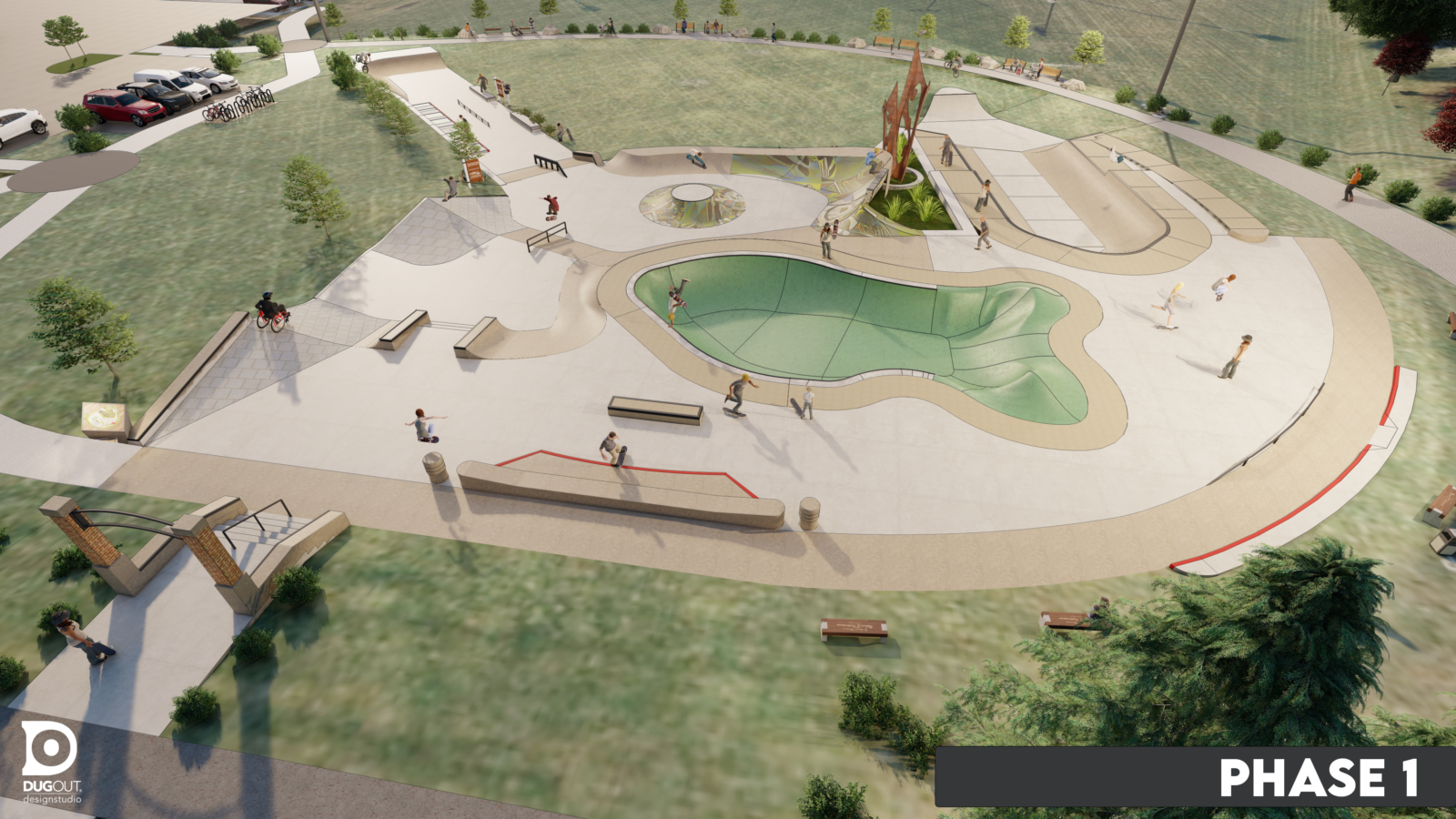
Rendering of the upcoming Flounder & Friends Skatepark in Valparaiso, Indiana. Site engineering and surveying provided by Abonmarche.
What does a community skatepark look like today?
Valparaiso, Indiana is reimagining what’s possible as it brings a modern skatepark experience to a new generation of skate enthusiasts — and a new community gathering place for residents and visitors to enjoy as the city of Valparaiso continues to thrive and expand.
Our team in Valparaiso has served as the engineering force supporting the project, and we’re excited to share that the site’s stormwater improvements kicked off earlier this spring.
This new skate park is such a fantastic development project to be a part of,” notes Matt Keiser, engineering project manager at Abonmarche. “The experience of moving through the process of designing the necessary stormwater improvements and site surveying – it’s extremely rewarding to know that our engineering work beneath this new park is what supports all of the action going on above ground.”
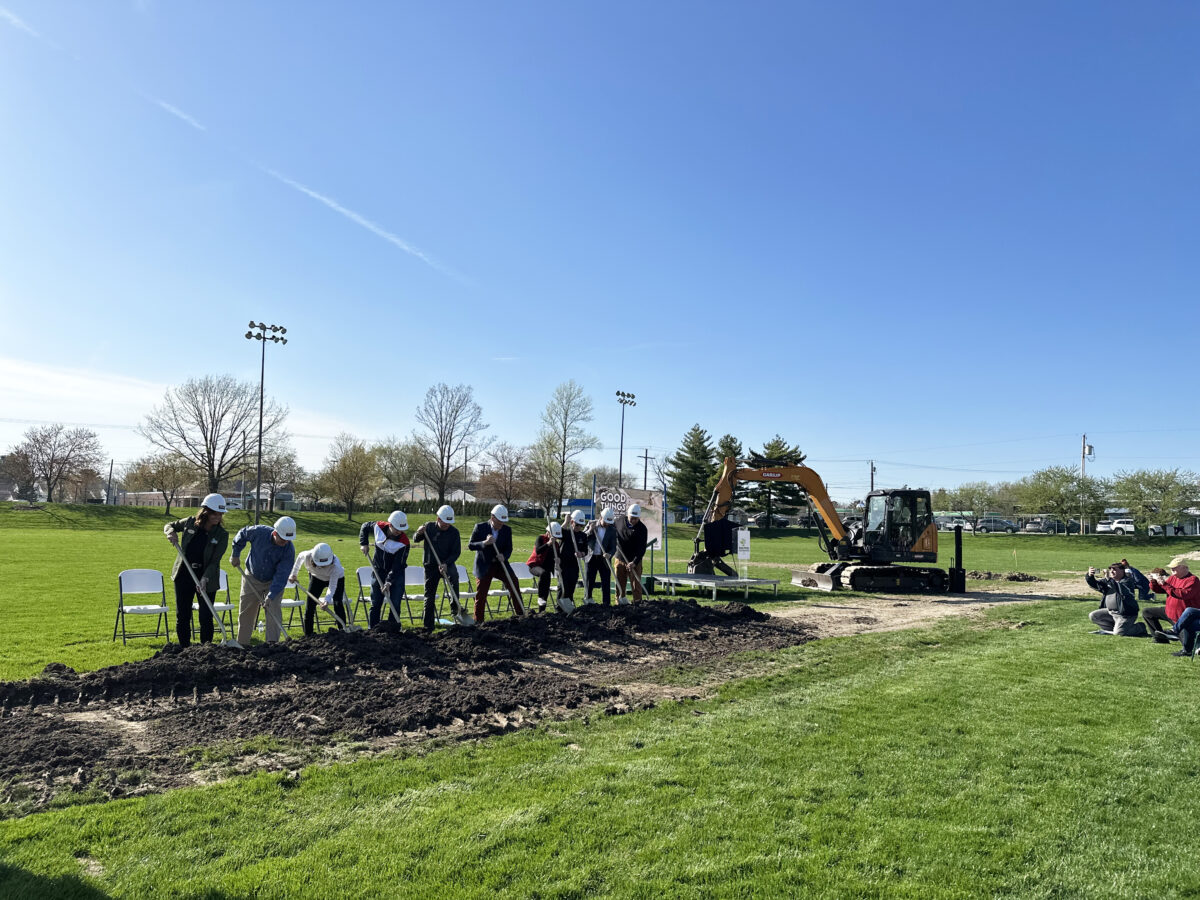
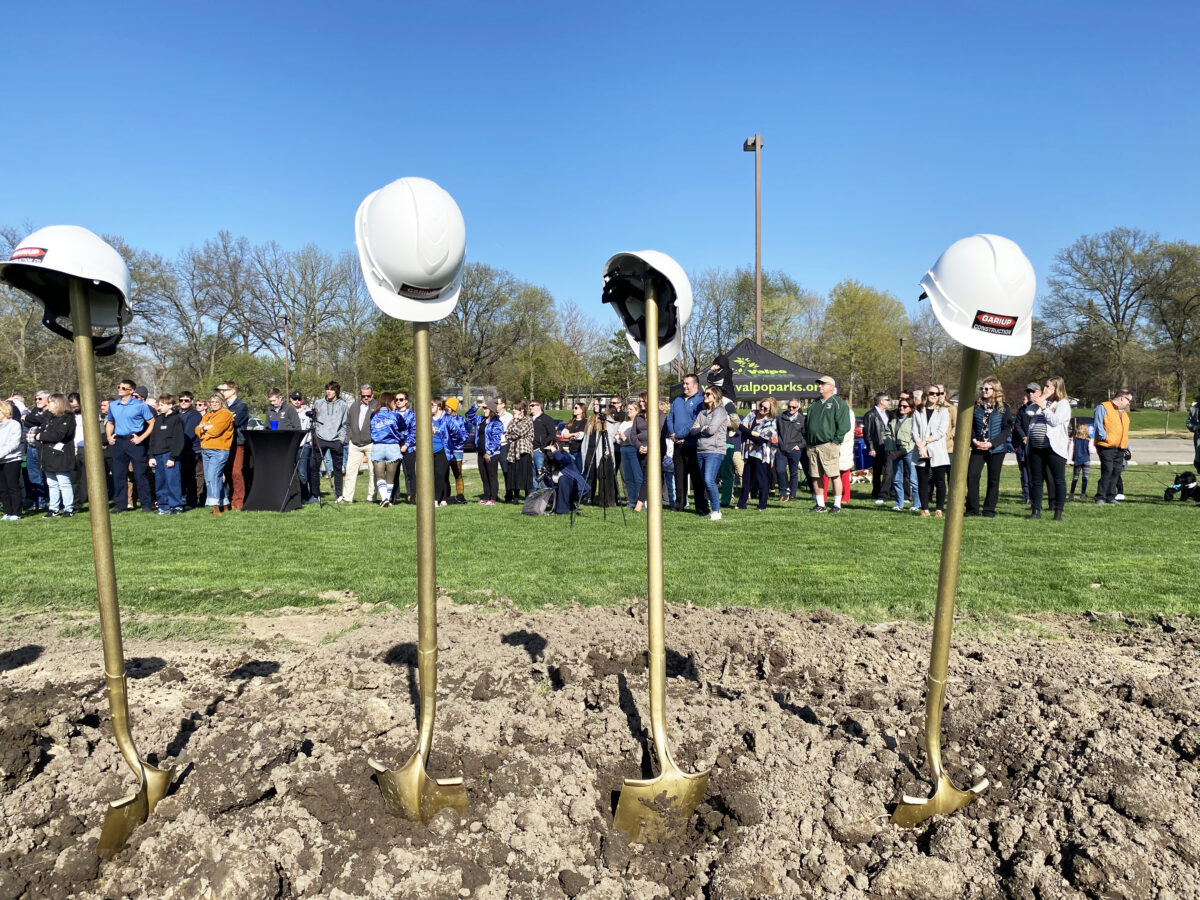
A formal groundbreaking ceremony Tuesday, April 18, kicked off new phases of the project and unveiled the new skatepark’s name – Flounder & Friends Skatepark.
“With purpose, this park will welcome people with adaptive needs, with purpose this park will welcome people of all ages and skill levels, and with purpose this park will welcome residents and friends of Valparaiso,” said Kevin Nuppnau, assistant director of Valpo Parks, during the ceremony. “We’re not just saying it, we are building it, and it starts today.”
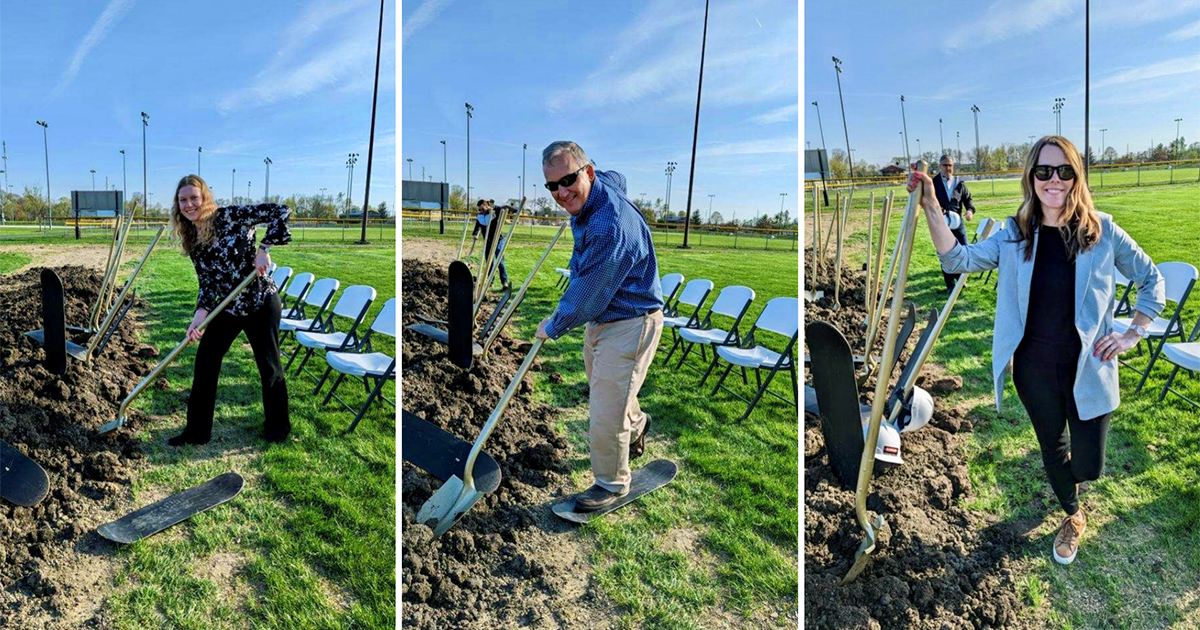
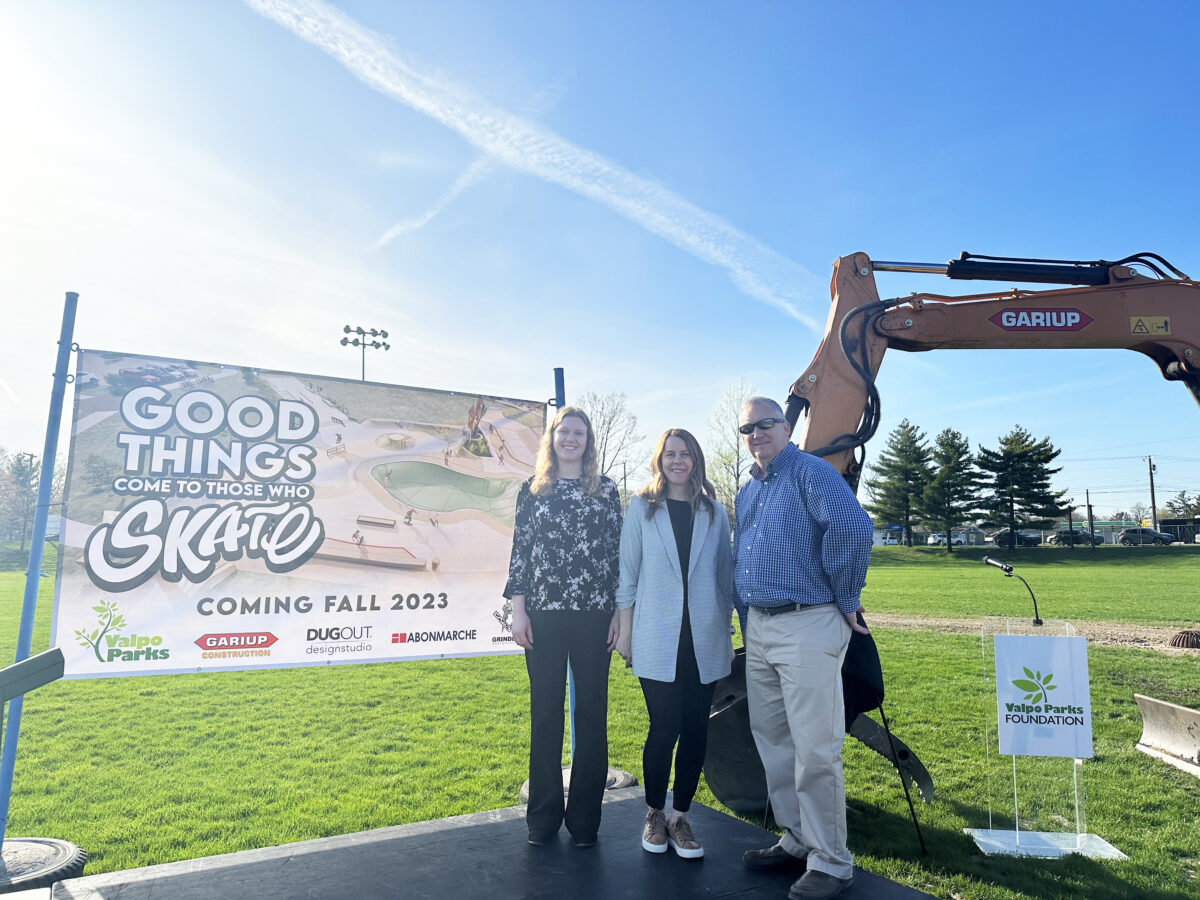
Members of the community of Valparaiso and project team members broke ground at the site of the upcoming state-of-the-art Flounder & Friends Skatepark in Valparaiso, Indiana. Abonmarche project team members Lara Brown, Matt Keiser, and Tara Boyanski helped kick off new phases of the skatepark.
Flounder Skatepark — A New Community Experience
As in every community redevelopment project, the City of Valparaiso hosted an in-depth community engagement effort to understand what people wanted from a new skatepark experience, what was important to them in the park’s features and location, and how the park might bring residents and visitors together in a way that most skateparks fail to do. To maintain the project’s vision and ensure the skatepark becomes a reality, a task force was established among the design and engineering teams, Valpo Parks, and local skate enthusiasts.
In contracting a designer for the new skatepark, the City of Valparaiso reached out to Valparaiso native and X Games Course Design Dug Ketterman, of DugOut Design Studio. Ketterman, a venerated skate park and course designer who has designed some of the world’s most beloved skate experiences, has a special connection to his hometown’s original skatepark.
As a 16-year-old in the mid-1990s, Dug and his friends came to the city of Valparaiso to find a way to design a place to skate. They helped the city design and construct the skatepark, piece by piece. The finished design was named Flounder Skatepark in honor of Dug’s friend Ray “Flounder” Wampler, who was killed in a car accident on his way to school one morning. The first Flounder Skatepark stood from 1998 until 2020, when it closed due to its level of disrepair and unsafe conditions.
Valparaiso reconnected with Ketterman after 20 years to lead the design of a new park in a better location. Once built, the new skatepark will again carry the Flounder name — and will inject the same passion that Valparaiso area skaters bring to their art.
Nestled in the Heart of Valparaiso
To host the site of its new skatepark experience, Valparaiso and its design partners conducted a thorough site review and analysis—eventually selecting a section of its existing Fairgrounds Park. This was a significant departure from the old skatepark location, which was nestled deep into a 122-acre hiking park on the city’s north side; in contrast, the new location, in the center of town and along one of the city’s main thorough-fares, was chosen for its visibility and walkability within the community.
As part of Fairgrounds Park, the new skatepark will be enveloped by a 3/4 mile walking track and situated adjacent to 4 softball fields, a playground, a community pavilion, and a Life Trails System, designed to help adults ages 50+ with functional fitness.
Valparaiso’s park and recreation options are ideal; with more than 700 acres of parkland spread across 17 parks, 27 athletic fields, 14 children’s playgrounds, and two golf courses, people in every corner of the city have a unique park experience to call their own.
With the old skatepark in disrepair, the decision to design a new one came with new opportunities: to create an accessible state-of-the-art skatepark and to shape a citywide gathering place for people from all walks of life.
Abonmarche’s Lara Brown, Tara Boyanski, and Matt Keiser attended the groundbreaking ceremony for the new Flounder & Friends Skatepark in Valparaiso, Indiana. The project is engineered by Abonmarche.
A Modern Skate Experience for All
During an extensive community engagement effort, the design team identified the community’s top desires, then created a design that could be implemented in phases as funding becomes available.
The new skatepark will feature spaces for skateboards, bikes, scooters, and skates — with an emphasis on user-friendliness for many ages and abilities, including beginner, intermediate, and advanced levels. Future phases of the skatepark design will feature a dedicated beginners area along with adaptive features for athletes in wheelchairs.
Ketterman’s design inspiration is “centered around the Golden Spiral, providing a harmonious aesthetic while encouraging growth and inclusivity around the world. We have designed a park that not only meets the needs of the community, but also redefines what is possible…”.
Space to Gather
Flounder Skatepark’s holistic design will reach beyond the city of Valparaiso to become a regional hub for the skating community — creating space for people of many interests, ages, abilities and locations to gather — to have fun, to be active, to learn, and to share in both failure and success. Building a skatepark as a space that will nurture the community of Valparaiso will spread benefits to many other communities across northern Indiana and beyond.
Design: DugOut Design Studios
Site Engineering & Surveying: Abonmarche
Advocacy: Driftwood Collaborative
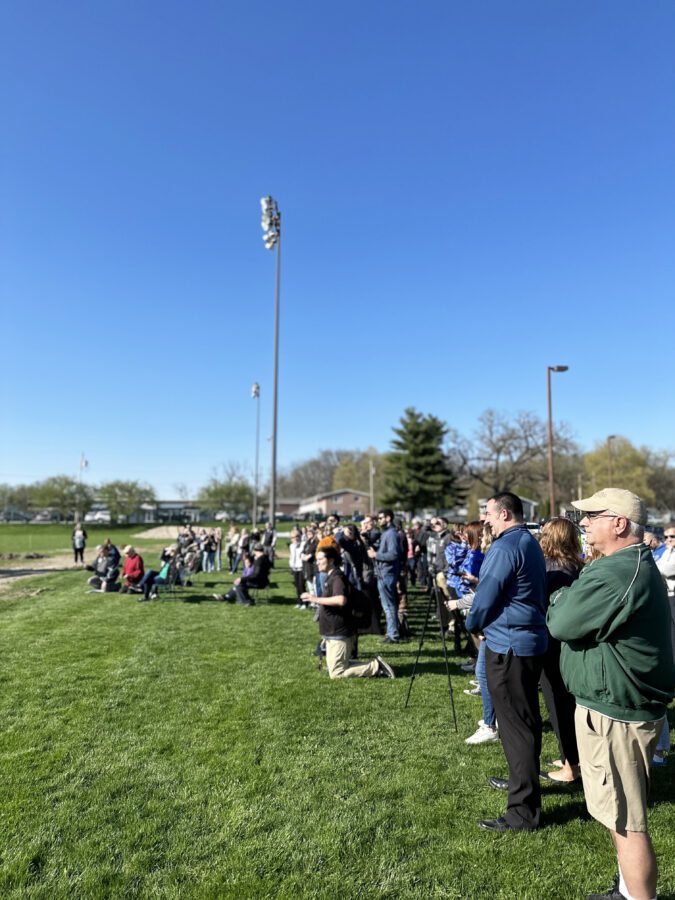
The groundbreaking ceremony saw an excellent turnout by Valparaiso community members, sponsors, and other project partners.
Contact Us today to learn more about our practice.
The State Revolving Fund | An Abonmarche Expertise
Wastewater improvement is an expensive, time-consuming investment that does not happen often.
Indiana’s State Revolving Fund (SRF) program provides low-interest loans to Indiana communities for projects that improve wastewater and drinking water infrastructure. This program helps to protect the environment and public health.
Indiana’s State Revolving Fund (SRF) can unlock valuable funding for your large-scale projects, and Abonmarche can help get the ball rolling. Using the SRF is a great way to understand your community’s needs and vulnerabilities, start making changes, and begin to plan for the future. Taking advantage of the SRF is a great way to finance your community’s projects, and Abonmarche can provide the engineering, surveying, architecture, and structural engineering services to support those projects.
About the SRF
Eligible candidates include cities, town counties, regional sewer/water districts, conservancy districts and water authorities. As of recent, nonpoint source projects are also included in this. Specifically, these eligible candidates must apply for this with only projects where there is an existing pollution issue. The money for this program comes from each specific state applying for the U.S. Environmental Protection Agency annually for capitalization grants.
Wastewater projects may include:
Treatment plant improvements and upgrades
Sewer line extensions to existing unsewered properties
Combined sewer overflow corrections
Infiltration/inflow projects.
Drinking water projects may include:
Treatment plan improvements and upgrades
Water line extensions to existing unserved properties
Water storage facilities
Nonpoint source projects may include:
Wetland protection and restoration measures
On-site sewage disposal systems
Best Management Practices for agriculture and stormwater runoff
Riparian Buffers and Conservation Easements
Wellhead and Source Water Protection measure.
Projects not eligible for funding:
Private and not-for-profit facilities are only eligible for drinking water SRF Loan Programs. Additionally, projects that are solely intended for economic development, that are primarily for fire suppression, and/or that have no water quality benefits are not to be considered eligible.
How Abonmarche Can Help
The SRF loan is useful for communities that have large projects requiring funding and completion assistance. Abonmarche can service these communities throughout the entire process, including applying for the funds, creating and sealing the required Preliminary Engineering Report (PER) and associated forms completion. We’ll be able to provide solutions, alternatives, and preliminary designs based on the PER findings. Asset management plans for the system are also required to apply for SRF, and the engineering team at Abonmarche is well-equipped to handle the in-depth nature of water asset management plans.
Abonmarche SRF Services Include:
SRF Application Management
Preliminary Engineering Report (PER) and Forms Completion
Asset Management Plans
Surveying & Engineering associated with the project
Construction Inspection
Our SRF Projects Happening Near You:
New Chicago Water Works – System Improvements
Town of Demotte – I-65 Drinking Water & Wastewater Utilities Extension
NORWEJ – East Side Drinking Water Expansion Improvements
Benton Harbor, MI – Pipestone Area CWSRF & DWSRF System Improvements
To learn more about how Abonmarche can help bring vital SRF funding to your community contact our Valparaiso office at (219)850-4624.
Abonmarche Brings Community Crossings Grant to Northern Indiana
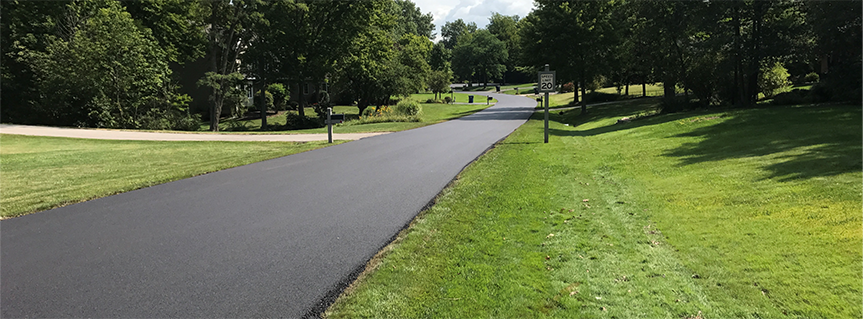
The Community Crossings Matching Grant program is part of Indiana Governor Eric J. Holcomb’s Next Level Roads program, a 20-year, fully funded plan to enhance Indiana’s highways and local roads by awarding communities grants for shovel-ready local road construction projects.
Over the last five years, Indiana has awarded more than $830 million in matching funds to support local road and bridge projects around Indiana.
Abonmarche has been instrumental in helping several communities secure grant funding for local road projects, and it is our goal to bring this grant and its benefits to more of the Northern Indiana communities we serve – helping cities, towns and counties complete additional projects in their jurisdiction to spur community growth and development.
Projects eligible for funding through Community Crossings include road resurfacing, bridge rehabilitation, road reconstruction, small structure replacements, and Americans with Disabilities Act (ADA) compliance in connection with road projects. Material costs for chip sealing and crack filling operations are also eligible for funds.
While this grant presents great opportunities to Hoosier communities, it also presents many hurdles to those who want to apply.
THE CHALLENGE TO INDIANA COMMUNITIES
The grant application and management process can be overwhelming for municipalities of any size, but particularly those communities on the smaller side. Community leaders are trying to balance budgets and staffing limits with the need for supplying added value, community improvements, and future planning.
Each project submitted to the Indiana Department of Transportation (INDOT) for funding is carefully evaluated based on need, traffic volume, local support, the impact on connectivity and mobility within the community, and regional economic significance, noted INDOT in a January 2021 news release. The hoops municipalities need to jump through are significant, but hiring a full-service firm like Abonmarche can make grants like Community Crossings attainable.
“We’ve become very well-versed in how the grant works because we started working with it as soon as INDOT released it in 2016 and have continued non-stop every call for projects that has occurred,” says Matt Keiser, Project Manager at Abonmarche Valparaiso. “As the grant and its administration has evolved, we’ve modified our processes to embrace these modifications with our community leaders. We’ve found that working directly with the Public Works Directors and Clerk-Treasurers, we can properly manage all of the complex moving parts and timeframes involved within the confines of the grant requirements.”
DID YOU KNOW?
Community Crossings is open to all towns, cities, and county government units in the State of Indiana.
The Community Crossings grant gives approximately $160 million/year, and there are many communities who have lost out, by being unprepared or unresponsive to the grant deadlines.
To be eligible for the Community Crossings grant, a municipality must reassess their roadways every two years and update their Pavement Asset Management Plan every year.
Matching funds range from 50 to 75% depending on the size of the community.
INDOT calls for Community Crossings projects twice each year.
The next call for projects is planned to be in July of 2021.
For smaller entities that don’t have the funds and/or staffing, the Community Crossings Matching Grant can be a huge undertaking to try to accomplish in-house.
“This grant gives you the ability to bring tangible improvements to your community, while staying focused on all of the day-to-day work involved in keeping your community on track and running smoothly”, Keiser notes. “Working with our firm on this grant can save valuable time and resources, taking the minutiae off the backs of everyone from superintendents to road commissioners and public works staff so that they can focus on their everyday work.”
Because the grant process is so involved for Community Crossings, we have touchpoints with our clients throughout the entire year, keeping them up-to-date on progress, upcoming deadlines, and getting the grant off the ground and running in their project.
A STREAMLINED GRANT MANAGEMENT PROCESS
Since an INDOT/LTAP approved Pavement Asset Management Plan is required, Abonmarche completes a field assessment of every road segment, utilizing the PASER Rating System. When the assessment is complete, we analyze the results and create a comprehensive Pavement Asset Management Plan, based on the required elements to qualify for the grant.
Abonmarche then can offer assistance in the selection of the projects to be submitted for grant application. After the project list is finalized, our team helps prepares the grant application along with all of the necessary documentation required for submittal.
Once grant funding is awarded, Abonmarche creates the plans, specifications, and bid documents to secure pricing meeting the States requirements for Public purchasing. For many of our clients, we have also provided construction management services for the duration of the projects to ensure the projects are built to the design standards and the grant application.
“Our fees are stable, and our clients know how much our fees will be for their next years of planning,” Keiser says. “There’s a layer of transparency we build into our process that helps these communities plan for the future in a way that they might not otherwise be able to. That element of planning ahead, and knowing which roads need work ahead of time, is invaluable.”
For more information about how Abonmarche can help bring Community Crossings grant funding to your area, contact Matt Keiser at (219) 246-4195 or at mkeiser@abonmarche.com.